 Bamberg
Introduction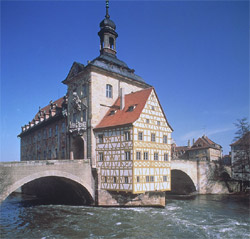
As you step off the train at Bamberg station the first thing you notice is the
delightful scent of malt in the air. The town has 10 major breweries, lots
more on the outskirts, and the space between the breweries is filled with
excellent pubs . . . oh, and a few shops . . . and a cathedral and other tourist
sites. Add to that the attractive appearance of the town with the old Fachwerkhäuser (half-timbered buildings)
overlooking the river Pegnitz and the fact that this is the home of
Rauchbier
(smoked beer - one of the most distinctive styles of Germany and our favourite),
and you'll see why the town is a magnet for anyone interested in beers.
UNESCO has declared Bamberg to be a World Heritage City and the EBCU (European
Beer Consumers Union subsequently declared Bamberg to be a World Beer Heritage
City - what more recommendation do you need?
Should you manage to tire of the town's own attractions you can easily get out
into the Franconian countryside where picturesque villages turn out to have
their own small breweries whose products you won't find anywhere else.
These are covered very well by the 'Guide to
Bamberg and Franconia' on the
books page. The
Online guide to Bamberg and the Breweries of Franconia
also gives you a lot of help.
 For
information on the town itself, try the
official website - it's in German but you'll see a link to an
English version. For the real purpose of your visit - the beer -
For
information on the town itself, try the
official website - it's in German but you'll see a link to an
English version. For the real purpose of your visit - the beer -
 you can
start with a website which declares
Bamberg the veritable Capital of Beer.
(Actually it says it in German, but there is a link to an English version.)
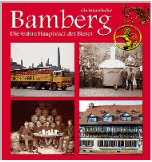
The site is based on a book by Christian Fiedler
which gives some good information on the history of the town and its breweries
and is well illustrated. You'll find copies on sale in the town or you can
order through the website. The page headed 'Links' is rather nice, as it
offers you the logos of all the main breweries, and clicking on them takes you
to each brewery's website.
you can
start with a website which declares
Bamberg the veritable Capital of Beer.
(Actually it says it in German, but there is a link to an English version.)
The site is based on a book by Christian Fiedler
which gives some good information on the history of the town and its breweries
and is well illustrated. You'll find copies on sale in the town or you can
order through the website. The page headed 'Links' is rather nice, as it
offers you the logos of all the main breweries, and clicking on them takes you
to each brewery's website.
The town is also home to the
Franconian Brewery Museum
- although the website offers you a Union Jack
to click on only a couple of pages have been translated into English, although
you'll find opening hours and a map without too much trouble.
The picture at top right is of the old town hall, dating from 1467. The story is that
the Bishop did not want to give any land to the citizens, so they built this
artificial island in the Pegnitz, the border between the clerical town on the
hills and the merchants' island. Whatever the reasons, it makes for
unusual and beautiful views.
The imperial cathedral of St Peter and St George with its four towers on one of
Bamberg's seven hills is the heart of the city. It dates back to Emperor
Heinrich II., who founded the diocese of Bamberg in 1007. The first cathedral
was consecrated in 1012, but it burnt down. The present building was finished in
1237 and contains many works of art, including the Bamberger Reiter ( Bamberg
Horseman), dating from around 1230. No one knows who it represents or who
the sculptor was, but its stylised outline is used as the town's logo.
Bamberg is an ideal town to explore on foot, with new delights popping into view
round every corner of its narrow, ancient streets. We managed to get lost
a couple of times but that's more difficult today, since large maps have been
installed at strategic locations to help pedestrian tourists. You'll find
our personal impressions of the town (and the beers) on the
following pages.