 Belgian
Beer Styles
Belgian
Beer Styles
Major beer styles of Belgium
A brief
description of the main types – for more technical detail consult
books by Tim
Webb or Michael Jackson.
But don’t feel that you have to know how the experts define a
beer, or what esoteric processes are used in its production. Remember that
the definition of a good beer is a beer you like, and just keeping a note of
the ones you have enjoyed is all you need to do!
LAGERS
Best to pass over this quickly, as it’s not the Belgians’ strong point.
LAMBICS
Unique to Belgium, based on spontaneous fermentation by wild yeasts,
followed by initial maturation, then ageing in oak casks. Good variants can
be laid down like a wine and improve with further ageing in bottle.
Draught Lambic
Increasingly rare but can still be found in some café-bars in Brussels,
the home of lambics.
Faro
Sweetened lambic, can occasionally be found on draught as above, and is
available bottled.
Oude Gueuze
Great gueuze is made by blending lambics and is a drink unlike any
other. It should be approached with caution and the first taste is likely
to be a shock to the system. Best in Belgium, as it doesn’t seem to travel
too well. Best examples are by
Cantillon (and even better tasted in
their own brewery/museum), Girardin (no website) and
Drie Fonteinen.
Commercial Gueuze
Unfortunately the commercial considerations produce a wide divergence in
quality and you need to taste a lot to be able to form an opinion – we’re
still working on it!
Cherry lambic
Kriekenlambiek is usually abbreviated to kriek, the name of the Belgian sour
cherry, so every beer which has been near a cherry-flavoured substance tends
to call itself kriek. Can be found draught but mainly bottled. A
traditional style is sometimes distinguished by the name Oude Kriek and
these can be laid down – at first they show intense fruit, but with time the
sharper lambic taste shows through, giving an interesting range of
flavours. However, some of the more commercial styles can, if done well,
produce a very pleasant drink, so try lots and make up your own mind!
Raspberry lambic
Frambozen in Dutch, Framboise in French – all the comments made about kriek
apply here.
Other fruit lambics
A lot of these are the Belgian equivalent of alcopops and aimed at a
similar market, but don’t disdain them all – some of them, by the better
brewers, can be quite pleasant.
ALES
It is the ales of Belgium which have made the country’s reputation for beer. While we Brits quaff large volumes of low strength draught ales of three main styles, the Belgian and Dutch sip a vast array of bottled ales of all strengths and dozens of distinctive styles. This makes it difficult to categorise them, so the following notes are really just a check-list of the main headings – but be aware of the huge diversity, and get a good reference book if you want to get to grips with it.
Trappist beers
Not a beer style, this simply denotes a beer brewed by monks in an abbey
ratified by the Vatican to use the label “Authentic Trappist Product”. At
present there are six approved locations – see following map. Although the
brewery at Val-Dieu is on abbey land, it is not run by the monks themselves,
so only qualifies as an Abbey beer – see below.
Most Trappist brewers (and the Abbey beers which imitate them) tend
to follow the system of producing a Blond, Dubbel (stronger, usually brown),
Tripel (strongest, may be blond or barleywine style)
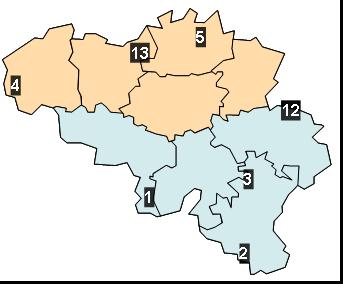
Trappist abbeys – those with breweries in bold - click on the name for a link to their website
|
Trappists |
Trappistines (Nuns) |
Cistercians |
|
|
Chimay, Scourmont (1) |
Clairefontaine, Bouillon (6) |
Brialmont, Tilff (11) |
|
|
Orval, Villers-devant-Orval (2) |
De La Paix, Chimay (7) |
Aubel, Val-Dieu (12) |
|
|
Rochefort, St. Remy (3) |
Soleilmont, Fleurus (8) |
Achel, Hamont-Achel Sint Benediktus, Bornem (13) |
|
|
Westvleteren, Sint-Sixtus, (4) |
Nazareth, Brecht (9) |
Cisterciennes (Nuns) |
|
|
Westmalle, Malle (5) |
Klaarland, Bocholt (10) |
Marienlof, Kerniel-Borgloon (14) |
Abbey beers
Some abbeys have commissioned brewers to make a beer on their behalf.
More commonly a brewer or wholesaler asks an abbey for a licence to use
their name in return for some income. Other brewers have adopted the name
of a defunct foundation – and so don’t pay commission – while many simply
invent names which sound like religious foundations or name their beers
after saints. They tend to produce a Blond (usually indistinguishable from
a non-abbey Blond), a Dubbel fairly strong (dark)brown ale and a Tripel –
the latter is often a strong Blond ale, although the line dividing them from
strong golden ales (like
Duvel ) or barley wines is wearing
thin. With these types they are imitating the Trappists, but most abbey
beer ranges also include a Bruin (brown) – which again is similar to
non-abbey browns. Rather than worry about the categorisation, it’s easier
to remember which ones you like! Try the
St Bernardus
range, also
St Feuillien and
Karmeliet Tripel.
Wheat beers
In 1966 Pierre Celis bought the old De Kluis brewery and revived
Hoegaarden (pronounced Who Harden if you’re in Belgium but if you find it in
a British pub – which is ever more likely – you’ll have to sound as though
you’re hoeing the garden to get served!). It’s a pale wheat beer, spiced up
and with orange peel and coriander added – a nice, refreshing drink but
suffering from commercial pressure since
Interbrew (now strangely calling
themselves In Bev, although I am reliably informed that the second word is
Antwerp slang for oral sex!!!) took it over. It’s meant to be cloudy which
is why the Flemish folk call it witbier which is pronounced like wheat beer
but actually means white beer, and if they want to say wheat beer they call
it Tarwebier – I hope that’s quite clear? (Well, it’s meant to be cloudy,
actually . . .) Anyway, quite a few other brewers produce their own
versions, and it’s worth experimenting to find your favourite. There are
also stronger versions – Hoegaarden has its own Grand Cru, and also a
Speciale, but the latter is harder to find.
Cask aged
brown ales
Some of these imitate
Rodenbach – q.v. – and are sometimes
called Vlaams rood – Flemish red – and then there are the ones which come
from the Oudenaarde area and are often called oud bruin – old brown. Try
’em!
Blond ales
There is little difference between the blond ales made in Flanders,
Wallonia, Holland, and down into France, by ‘abbey’ or non-abbey brewers.
They start to show more character when they become what Michael Jackson
calls ‘strong Golden ales’, of which the prime example is
Duvel –
Flemish for devil, and it can be evil if you unwisely over-indulge! Get it
from your local supermarket.
Amber ales
These completely confuse definitions by sitting between blond and
bruin. Often they are what some people call pale ales, the French call
ambrée and the Flemish often dodge the issue by calling them just ale or
special. They are generally easy drinking social beers, such as
de
Koninck or
Palm Speciaal.
One distinct group is the Saison beers, generally a speciality of
Wallonia. They were originally produced in spring with extra hops to
preserve them through the heat of summer, but now you can find them at any
time.
Brown ales
Another less than helpful definition covering any abbey brown ales which
are not classified as Dubbel, through some variants which are suspected to
be the brewer’s Blond with added dark sugars. In theory they should be
sweet, rich, dark sedimented, with varying degrees of burnt and caramelised
malt flavours. This means they start to come close to the category of
Stout, of which there are a number of Belgian examples, many tending to
the sweetness of a British Milk Stout, as opposed to a Guinness. Another
dark, sweetish strong beer is Scotch Ale now hardly ever made in
Scotland but still popular in Belgium, where it was thought to have been
originally brewed for servicemen in WWI.
Barley wines
This category is not officially defined, but Tim Webb’s book reckons
that any beer over 10% qualifies.
Seasonal
varieties
The Belgian breweries have an impressive array of kerstbieren -
Christmas beers – which are usually dark, strong and spicey and well worth
grabbing when you find them.
De Dolle Brouwers (the mad brewers) – a
small but fast-growing family concern which is well worth visiting – make a
point of creating several seasonal beers (like Stille Nacht for Christmas
and Bos Keun for Easter) which are only available in restricted quantities
at the appropriate time so watch out for them.
Flavoured
beers
Some beers which are loosely described as kriek but are in fact
non-lambic should really be classified under this heading, as fruit beers.
As with the fruit lambics, try a few of these because there are some which
make very pleasant drinks when you’re not really wanting a ‘serious’ beer.
More ‘serious’ variants are those which have spices added – sometimes this
is to mask a poor beer, but some brewers turn flavouring their spiced
beer into a fine art, and examples such as
Delirium tremens and
La Guillotine are highly rated. There is a trend – not only
in Belgium – to add honey to beer; sometimes this makes for a sticky
disaster but can also be surprisingly good – try
Zatte Bie
or
Barbär.